Lawns and meadows are classified as low-growing vegetation. Low-growing vegetation refers to plants of short stature (0.5–1.5 m in height), namely: low shrubs, perennials, groundcover plants, flower beds, and, of course, lawns and meadows. Low-growing vegetation serves aesthetic and recreational purposes, whilst also providing psychological comfort to residents. In the city, particularly in street-side areas, it protects against pollution, soil compaction and damage to tree root systems. It influences the city’s natural functions, increasing biodiversity and water retention. Low vegetation also plays a role in regulating the city’s climate, reducing the urban heat island effect.
Lawns
Lawns (turf) are areas of land covered with turf, which consists of compact vegetation with a dense root system. They are mainly composed of grasses. Lawns are resistant to trampling and relatively easy to maintain. The method and level of their maintenance are adapted to their function in gardens, parks, green spaces, squares, along streets, around buildings, at sports facilities and on slopes.
Audio description available on our YouTube channel.
Types of lawns
- carpet lawns – laid in representative areas,
- sports – laid around sports facilities,
- recreational – established in parks and green spaces,
- grass verges in road verges (roadside verges) – areas established in road verges with a secondary presence of spontaneous vegetation. These verges develop by ceasing frequent mowing of the lawn area, which has allowed new plant species to establish themselves (which are undesirable in the case of carpet and sports lawns).
When the frequency of maintenance treatments is altered, the species composition of plants on the lawn changes through the spontaneous seeding of other plants, including non-grass species, in accordance with the local habitat (so-called secondary succession). This occurs in the case of less frequently mown recreational lawns and roadside grasslands. During hot weather, the grass dries out and mainly tufted perennial ryegrass regrows, which destroys the effect of an even turf – a tufted structure forms, creating empty spaces that are spontaneously colonised by other plants. In the face of ongoing climate change, the drying out of grass in roadside areas is a phenomenon that is difficult to prevent; therefore, the presence of dicotyledonous species (especially from the Fabaceae family), which regenerate more quickly and are more drought-resistant, is a positive development.
Lawn maintenance
The basic lawn maintenance task is mowing, which is essential for maintaining the lawn throughout the season as a uniform, green turf. Mowing prevents grasses from flowering and setting seed; it also encourages root growth and thickens the turf.
Other treatments include fertilisation, watering, aeration, and the removal of dead plant matter through scarification and raking.
In urban areas, a varied mowing schedule applies, adapted, amongst other things, to local conditions, the habitat, plant species composition and the function of the area. For example, formal and sports lawns require systematic and frequent mowing.
We mow lawns to maintain:
- the aesthetic appeal of a given location, e.g. in historic buildings or representative areas;
- opportunities for rest and recreation (sports pitches, park glades, etc.);
- safety for those using roads and pavements (visibility) – in the case of roadside grass verges.
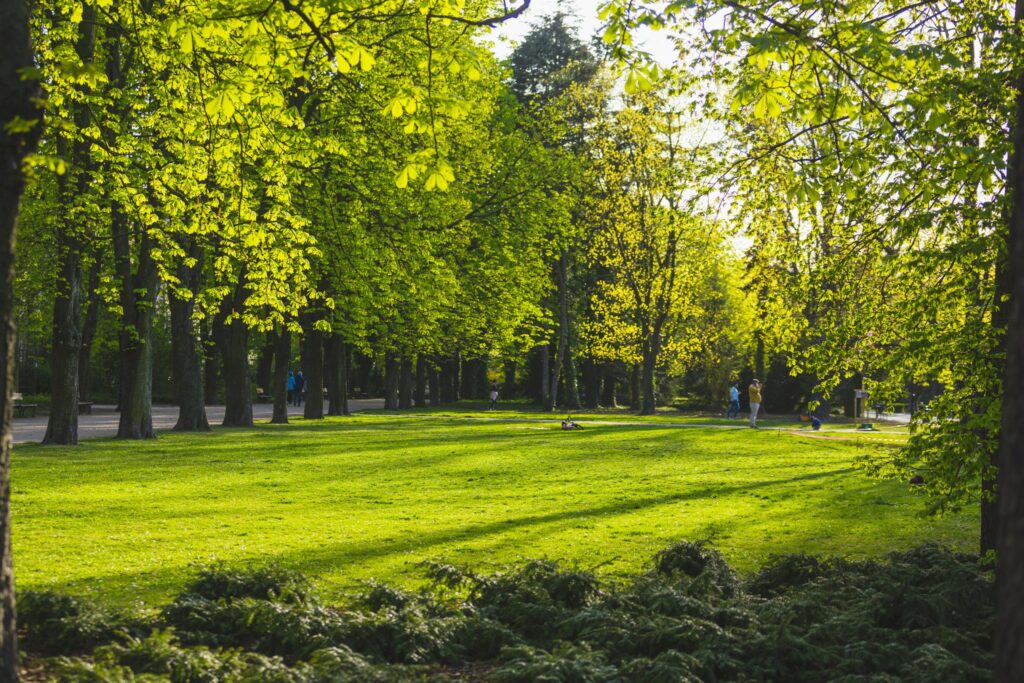
A recreational clearing in a park.
When planning the mowing schedule, we follow these principles:
- frequent mowing, up to 10 times a season – in prominent lawn areas (e.g. formal lawns, around perennial beds or where irrigation systems are in place) and on sports pitches. We also mow frequently on newly laid lawns, as this promotes the spread of young grasses (thickening of the turf);
- Mowing three times per season – for roadside lawns and those near areas with heavy traffic. This is a necessary measure for road safety reasons, as required by traffic regulations and building legislation (requirements regarding sight lines and the maintenance of clearance limits in relation to sight lines and the horizontal clearance of carriageways and cycle paths), as well as for maintaining order and cleanliness along transport routes (tall grass harbours rubbish that is difficult to remove);
- Mowing once or twice per season, or once every two years – in the case of urban meadows, where limiting mowing will promote species diversity and improve aesthetics. This is necessary to prevent the area from becoming overgrown with self-sown trees and shrubs or to eliminate invasive species.
Other maintenance treatments
- Scarification
This treatment involves cutting into the turf and removing thatch from the lower layers of the sward. After scarification, the grass receives more light, is better oxygenated and absorbs water more effectively. We do not carry out scarification under tree canopies.
- Aeration
This treatment involves aerating the soil in which the grass grows, for example by puncturing the turf. This treatment improves air supply to the soil to ensure proper root development, loosens compacted soils (e.g. clay soils), and facilitates the penetration of water and fertilisers to the roots. After scarification and/or aeration, sanding of the turf can be carried out to loosen compacted soil, allowing oxygen essential for proper development to reach the roots.
- Leaf raking
This prevents lawn degradation and helps maintain safety and cleanliness, e.g. along roadsides. For environmental reasons, we limit raking in parks and leave sections as so-called wildlife zones, where we also limit mowing. In many places, we create piles from the raked leaves. Leaving the leaves to decompose creates humus. Additionally, the layer of leaves retains water. Leaves piled in heaps also provide shelter and food for animals – invertebrates, amphibians and small mammals – which in turn serve as food for other predators.Due to the frequency of leaf raking, urban green spaces are divided into zones where fallen leaves are removed systematically (e.g. roadside green spaces, so that fallen leaves are not blown onto traffic routes and do not create a slippery surface; recreational areas, playgrounds, outdoor gyms, lawns adjacent to footpaths and pedestrian squares; formal lawns and carpet lawns, and areas beneath chestnut tree canopies, which helps to control the chestnut leaf miner). Areas where we do not rake leaves include, amongst others, areas under trees, in shrub clusters, on perennial beds and in wildlife areas.
Urban meadows
Urban meadows are grassy communities with a high proportion of dicotyledonous plants (perennials). In terms of species composition, meadows resemble semi-natural grasslands – meadows and pastures. In the city, we distinguish between two types of meadows:
- urban meadows that have developed spontaneously on lawns and park grasslands through reduced mowing and secondary succession,
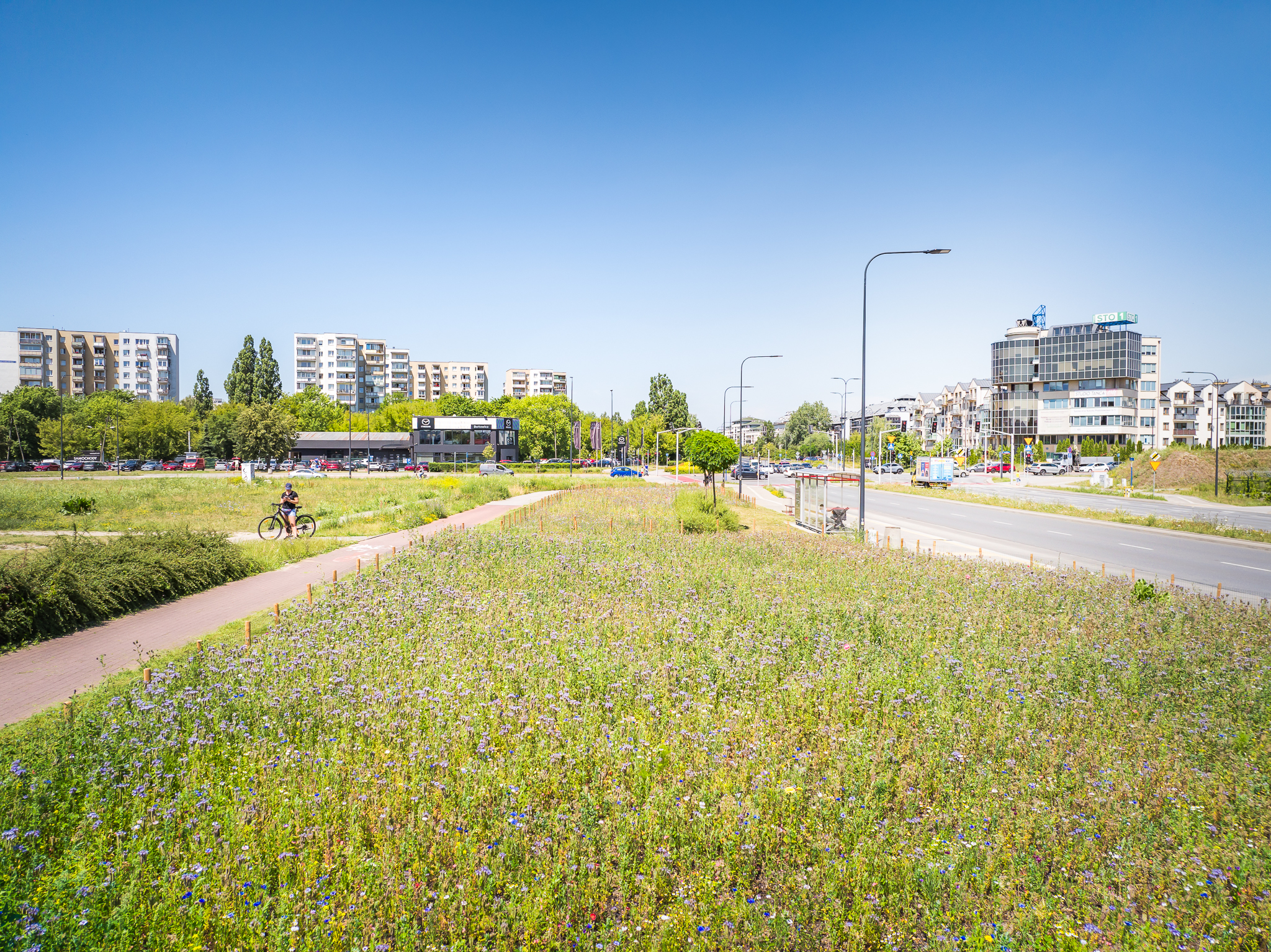
- meadows specifically established by sowing – a costly process, recommended only for newly established biologically active areas.
-

-
A recreational clearing in the park.
-

-
Areas that have been mowed and those that haven’t in the park.
-

-
Strips of mown and unmown grass along the street.
-

-
A flower meadow in Bielany – dominated by poppies, cornflowers, and dyer’s rocket.
-

-
A flower-filled meadow.
-

-
A flower-filled meadow.
-

-
A flower-filled meadow by the footpath.
-

-
Areas of tall, unmown grass in the park, forming a natural meadow.
-
-
A wildflower meadow created by sowing seeds within the road verge.
-

-
Butterflies in a flower meadow.
-

-
Sowing the meadow.