

SEARCH


Shrubs are an important part of urban greenery; they bring harmony and order to public spaces, enhancing their aesthetic appeal.
Shrubs are also vital for supporting biodiversity. Those that flower in spring and summer attract insects, whilst those that bear fruit in autumn provide a food source for birds. During the breeding season, shrubs provide important habitats for low-nesting birds (redstart, blackbird, dunnock). Urban parks with a well-developed shrub layer are characterised by a richer diversity of bird species. For Warsaw’s winged inhabitants, these plants also serve as stopping points – during wintering and migration, they provide safe shelter.
Shrubs are perennial plants with woody stems. Based on their height, we classify them as:

Newly planted shrubs in the roadside green belt.
Ground-cover shrubs up to 1 m tall form a large group in urban greenery, providing an excellent alternative to lawns. This type of vegetation does not create barriers that restrict visibility in the street-side space. Species that tolerate pruning are used to create borders and hedges. However, due to the labour-intensive nature and cost of maintaining such plantings (requiring pruning at least three times a year), it is best to limit the use of hedges and plant species taking into account their final size in a given location. Ground-covering shrubs, by shading the soil, protect it from erosion, reduce its heating and limit water evaporation.
Shrubs are often planted to form single- or multi-species groups. In hybrid borders, shrubs can be used as focal points.
The largest in size are solitary shrubs, which exceed 1.5–2 m in height. These are shrubs with a tendency to form trunks, such as black elder or common lilac, or those grafted onto a trunk. They can serve as an alternative to trees in places where planting trees is impossible due to, for example, interference with technical infrastructure, limited root space or difficult soil conditions. Such shrubs are no longer classified as low-growing vegetation.
Shrubs are used to create hedges, which can form borders for flowerbeds, mark out pathways, or separate the pavement from the road with a ‘green wall’, for example on Wawelska Street. They act as a buffer against wind and pollution.
Climbers form a specific group of woody plants, which are increasingly planted as ground cover, for example in places where lawns do not thrive. We also use climbing plants to conceal unsightly or uninteresting infrastructure elements or fences. By planting them against suitable supports, we can quickly create a shaded spot and a habitat for insects, birds and small mammals.
Shrubs constitute a very broad group of plants, so there is always a suitable species for every habitat. Although shrubs have shallower root systems than trees and it is easier to improve their soil conditions, the right choice of species is crucial for the plant’s proper growth in a given location. When selecting shrubs for a specific site, our gardeners take various factors into account, including sunlight, soil conditions, existing vegetation and potential exposure to salt spray.
In park settings, we strive to preserve and introduce historical varieties to maintain the coherence and character of the site.
To avoid the use of chemical plant protection treatments, we select species and varieties with high resistance to diseases and pests.
The shrubs we use to create our flowerbeds come from ornamental nurseries and must comply with, amongst other things, the quality guidelines of the Polish Nurserymen’s Association. In addition to having the appropriate size of the above-ground part and a well-developed root ball, the shrubs must be in good health and free from diseases and pests. For our plantings, we use both container-grown and bare-root shrubs.
The planting time depends on the type of nursery stock involved. Bare-root shrubs are planted during the dormant period, mainly in autumn, but planting in early spring is also possible. Container-grown shrubs can, admittedly, be planted throughout the growing season, but they are also most often planted in autumn or spring, as the weather conditions are most favourable during these periods.
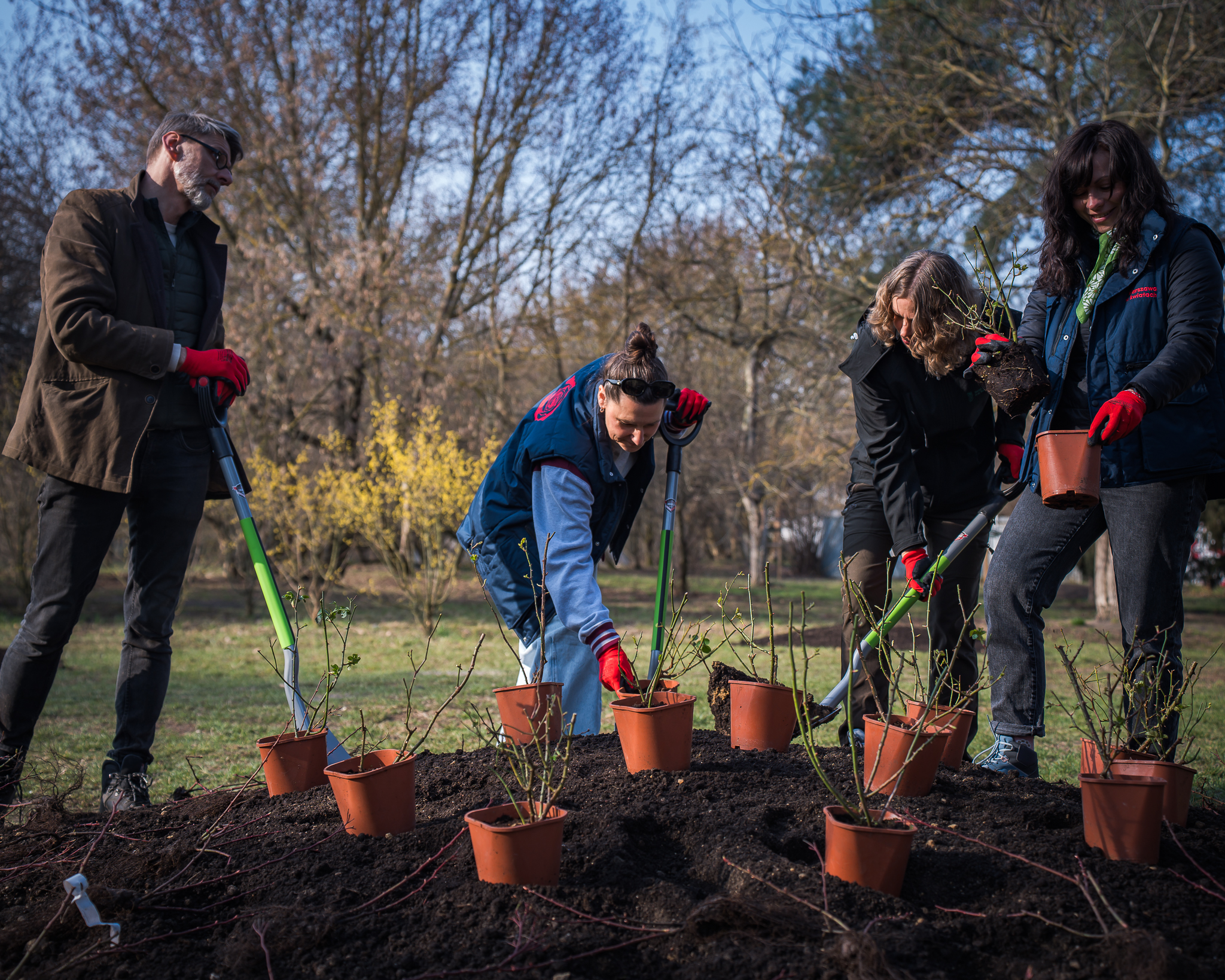
To create the right conditions for the shrubs to take root and grow, the first step is to improve the growing conditions by replacing the soil to ensure suitable air and water conditions. Depending on the location of the planned flowerbed, the work must be carried out by hand, e.g. near trees, and in other cases mechanically. Our team then takes the utmost care to place the plants in the planting holes, and after covering and compacting the soil around them, they water the plants to ensure the best possible conditions for them to get off to a good start.
After planting, young plants are watered regularly (at least 16 times over a 7-month maintenance period), and other maintenance tasks are carried out in accordance with contracts and the current instructions of the supervising gardener. The commissioned work includes weeding, fertilising, raking up debris and removing dead leaves and flower heads – these tasks are carried out by companies selected through a tender process for each district. In the case of older shrubs, such work is carried out at least once a year or on an ad hoc basis as required. Shrub pruning is carried out three times a year for hedges, and at least once a year for other plantings. Where necessary, rejuvenation or shaping pruning is carried out to address conflicts between shrubs and urban infrastructure.